These winged microchips are the smallest structures ever created by man | Gadget theory
Scientists have now developed a tiny winged microchip that is smaller than an ant’s head, which is the smallest flying structure ever created by humans. It’s an incredible feat of engineering, but the researchers behind the Northwestern University project are hoping that it means these structures can be used as air pollution monitors and airborne disease detectors in the future. Of course, there are concerns that they could be used for surveillance and mass data collection.
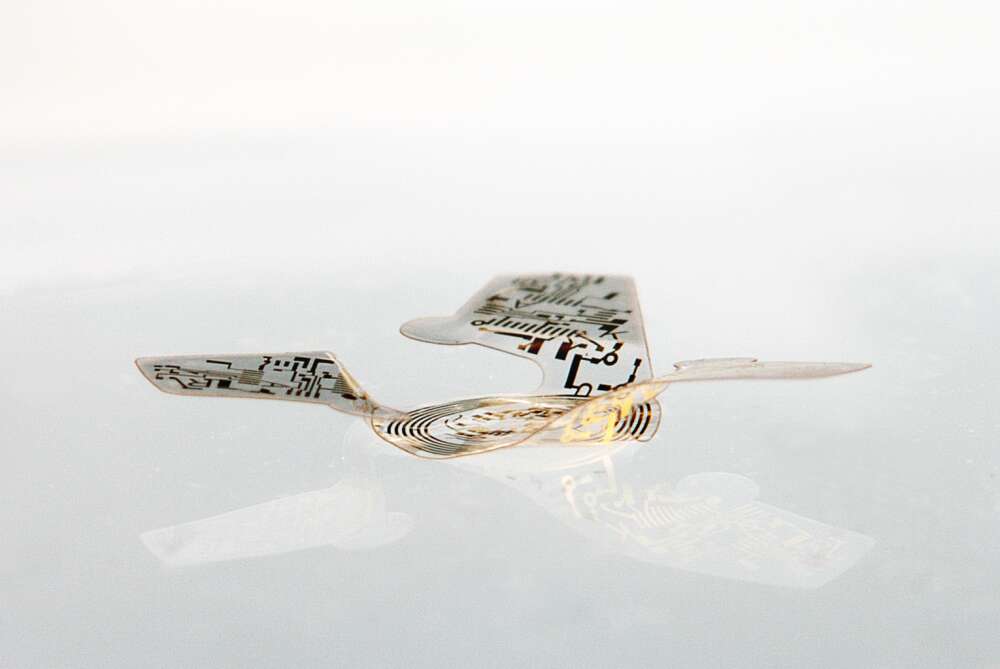
The design of microdevices
These tiny micro-devices fly through the air using a design inspired by airborne seeds that move in the wind. The researchers used various wind tunnel experiments and simulations to test different shapes. Some designs were inspired by dandelions, helicopters and spinners like the Empress Tree.
Ultimately, the winning design ended up having a three-wing structure that is similar to the tristellateia seed. Researchers even say it can glide even better than airborne seeds, which is truly amazing.
Professor John A. Roger, lead author of the study and bioelectronics expert at Northwestern, said: “We think we are beating nature. At least in the narrow sense that we were able to build structures that fall with more stable trajectories and at slower terminal velocities than the equivalent seeds you would see from plants or trees.
He continued, “We were also able to build these helicopter flight structures to sizes much smaller than those found in nature. This is important because the miniaturization of devices represents the dominant development trajectory in the electronics industry, where sensors, radios, batteries and other components can be built in ever smaller dimensions.
In order to avoid pollution, these devices are made from biodegradable polymers which will dissolve naturally after landing.
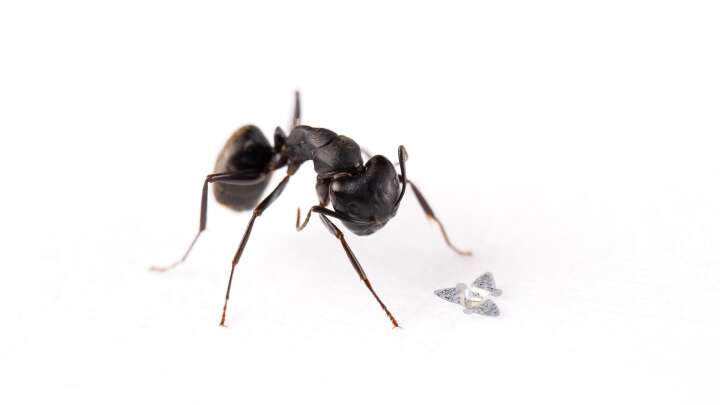
The device is smaller than the size of an ant head
Researchers have incorporated pH sensors that can monitor water quality as well as photodetectors that measure sun exposure at different wavelengths. They also showed that the device can glide with sensors, a power source that absorbs ambient energy, memory storage, and also an antenna that can wirelessly transfer data to computers. It’s completely crazy!
There are endless possibilities for this type of design. They can be used to monitor contaminations in the air, such as airborne illnesses or pollution. Of course, some exploits that it can be used for surveillance, such as tiny CCTV.
However, Rogers explained, “Most surveillance technologies involve bulk instrumentation designed to collect data locally at a small number of locations within a spatial area of interest. We envision a large multiplicity of miniaturized sensors that can be distributed at high spatial density over large areas, to form a wireless network.
Comments
Post a Comment